
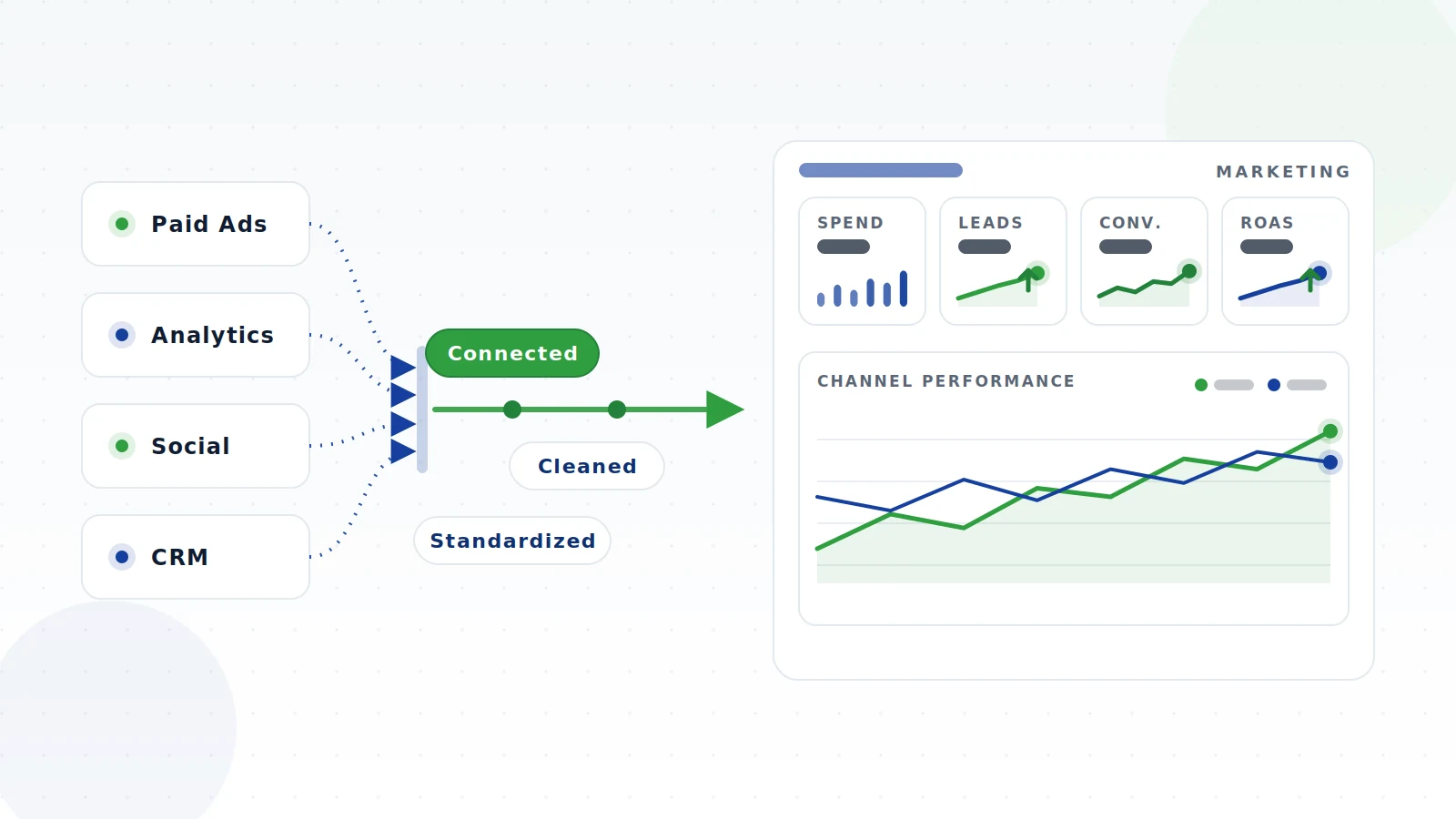
1. Why manual marketing reporting is so inefficient
Every channel has its own console, its own export format and its own definitions. Reporting manually means logging into each one, exporting, reformatting, and stitching the results into a spreadsheet or deck, then doing it all again next week. The work scales with the number of channels, not the size of the insight. Worse, manual assembly invites inconsistency: date ranges that do not quite match, conversions counted differently per platform, and one pasted-over formula that silently changes a KPI.
2. Know your marketing data sources
Most marketing reporting draws from three groups. Paid platforms: Google Ads, Meta Ads, Microsoft Ads, LinkedIn Ads, TikTok Ads and the rest of the channels you run. Analytics: Google Analytics 4 and Search Console for behavior, conversions and organic visibility. Marketing and CRM tools: email platforms like Klaviyo or Mailchimp and CRMs like HubSpot, where leads and pipeline live. List yours before automating anything; the sources define the report.
3. Connect the data
The first automation step is making the data arrive on its own. Each platform's numbers flow on a schedule into a central place, usually a spreadsheet or a dashboard's data layer, instead of through CSV exports. This connection layer is what our data automation service provides: scheduled collection, monitoring, and repair when a platform changes something, which they regularly do.
4. Clean and standardize the metrics
This step decides whether people trust the report. Different platforms disagree by default: attribution windows differ, timezones differ, "conversion" means five different things. Standardize before you aggregate:
- One reporting timezone and one date-range convention across every source
- One agreed conversion definition per goal, documented next to the data
- Consistent campaign naming, or a mapping table that translates platform names into your categories
- One currency, converted at a stated rate policy
5. Calculate KPIs once, in one place
Spend, leads, conversions, CPL, CAC, ROAS: define each formula in a single calculation layer that every report references. When the definition of ROAS lives in one cell instead of eleven slides, changing it is an edit, not an archaeology project.
6. Automated spreadsheet reporting
For most teams the destination is a spreadsheet, because that is where marketing managers actually work. An automated Google Sheet can hold raw channel data, the cleaned combined view, the KPI layer and a presentation tab that is always current. The full pattern is covered in our guide to automating business reporting with Google Sheets.
7. Dashboard reporting
When stakeholders need to watch performance rather than work with it, a Looker Studio dashboard presents the same connected data as live charts with date and channel filters. Dashboards shine for always-on visibility and for sharing with people who should see results but never touch formulas.
8. Recurring internal and client reports
Weekly channel summaries, monthly performance reports and client-facing reports are all the same machine with different presentation: the automated data layer fills a report template on schedule. Agencies producing this for many clients at once have their own playbook, covered on our marketing agency reporting page.
9. Common mistakes that break trust
- Automating before standardizing: fast delivery of numbers that contradict each other is worse than a slow manual report.
- No data-freshness check: a connection fails silently and the report keeps showing last week. Every automated report should show when its data last updated.
- Vanity completeness: forty metrics nobody reads. Report the KPIs decisions are made on, link out for the rest.
- One owner, zero documentation: when the builder leaves, the automation becomes a haunted house nobody dares to touch.
- Ignoring maintenance: platforms rename fields and deprecate APIs constantly. Automation without maintenance has a shelf life measured in months.
10. When managed reporting makes sense
If your channels are few and stable, building this yourself is realistic. Managed reporting earns its keep when channels multiply, when reporting deadlines are business-critical, or when nobody owns the maintenance. That is what our marketing reporting service does, with ongoing reporting management handling the monitoring, breakage and change so the reports stay true after launch.
Want this handled? Tell us which channels you run and who reads the reports. We connect the data, automate the reporting and maintain it. Get started or see pricing.